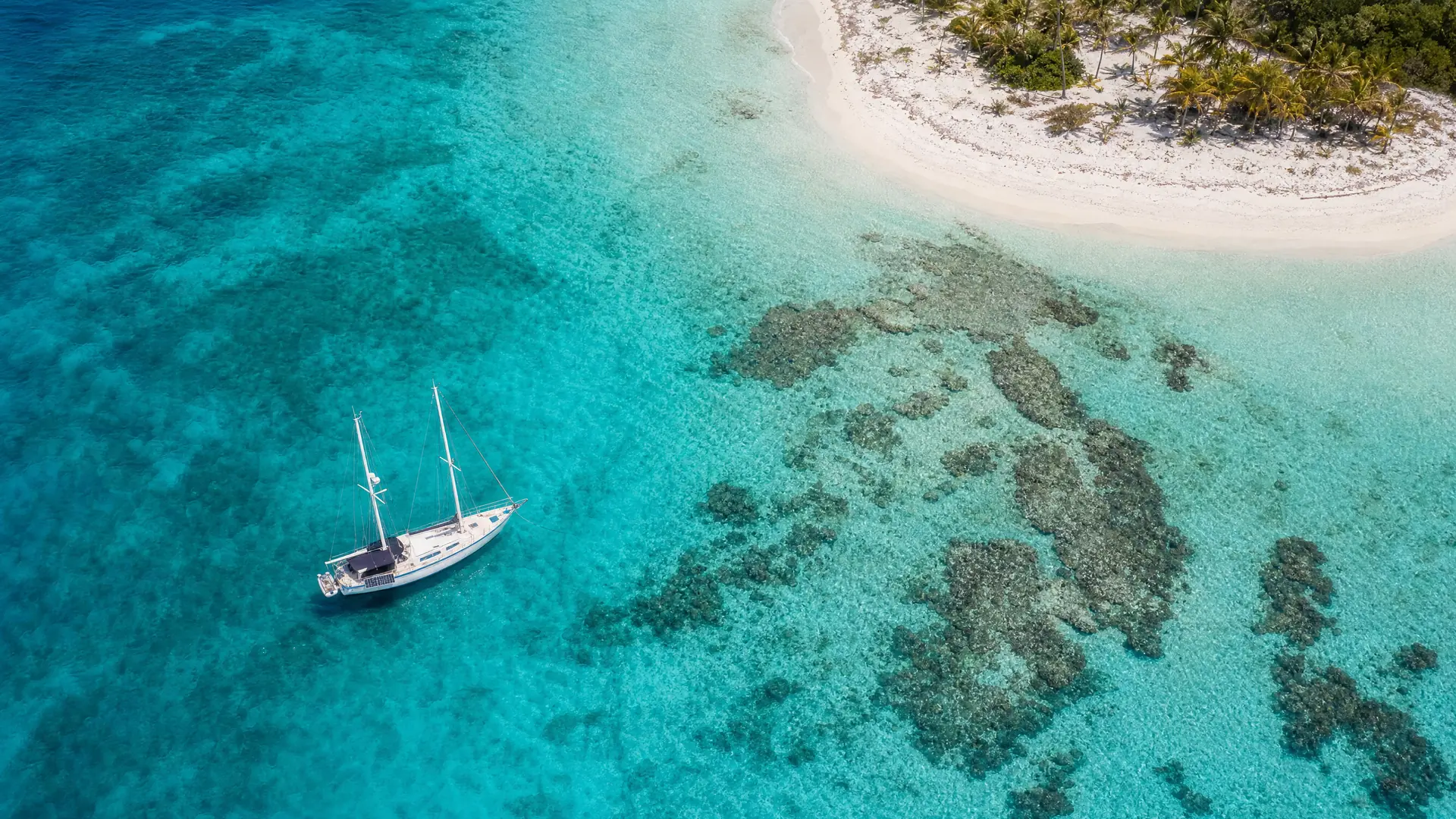
The Belize Barrier Reef runs along nearly the entire coast of the country we now call home, and after years of sailing it, we're still finding new corners of it. This guide walks through what's actually out there - the cayes, the three atolls, the reef's most famous (and most misunderstood) landmark - so you can plan a trip to the water that matches what you're actually after.
Is the Belize Barrier Reef Worth Visiting?
Yes - it's the second-largest barrier reef system in the world, and one of the most intact.
Only Australia's Great Barrier Reef is bigger. Belize's stretch runs about 190 miles (300 km) along the coast, part of the larger Mesoamerican Barrier Reef System that continues north into Mexico and south into Honduras - nearly 560 miles (900 km) combined. UNESCO added it to the World Heritage list in 1996, and Charles Darwin once called it "the most remarkable reef in the West Indies."
Below the surface, there's more than 500 species of fish and over 60 species of hard coral, spread across cayes, lagoons, and three of the four coral atolls in the Western Hemisphere.
Here's the honest part, too. The reef's health has been rated "poor" in recent survey years - 2.5 out of 5 in the 2024 Mesoamerican Reef Report Card - though that's actually an improvement, the first in years. Warmer water, coral disease, and runoff are real pressures on it. It's part of why we ask every guest to wear reef-safe sunscreen and keep hands off the coral: small habits, multiplied by every visitor who sails or swims here, matter more than they sound like they should.
What Are the Best Cayes for Snorkeling in Belize?
It depends on the trip you want - developed and social (Ambergris Caye), laid-back and small (Caye Caulker), or barely-there and close to the reef (Tobacco Caye, South Water Caye).
| Caye | Character | Best for |
|---|---|---|
| Ambergris Caye (San Pedro) | The largest, most developed island in Belize - more boats, more operators, easy access to deeper dive sites | Travelers who want variety and comfort, plus a base for Hol Chan and Shark Ray Alley |
| Caye Caulker | Smaller and slower - "go slow" is the island's unofficial motto - with its own Shark Ray Alley-style stop and the Swallow Caye manatee sanctuary nearby | Budget travelers, or anyone who wants a quieter island between reef days |
| Tobacco Caye | About five acres - you can walk around it in five minutes - with simple, rustic island stays | Anyone chasing the "stranded on a postcard" feeling without the price tag |
| South Water Caye | Larger and a step up in comfort, inside its own UNESCO marine reserve, with reef close enough to snorkel straight off the beach | Travelers who want that same castaway calm with better amenities |
One more worth knowing, even if you'll never dock there: Carrie Bow Caye, a speck of an island near Tobacco and South Water Caye, has hosted a Smithsonian research station since 1972. More than 500 scientific papers have come out of a caye you could nearly swim around - a nice thing to know as you sail past it.
Turneffe, Lighthouse Reef, or Glover's Reef: Which Atoll Should You Visit?
Turneffe for variety and easy access, Lighthouse Reef for the Blue Hole and beach snorkeling, Glover's Reef for getting away from everyone else.
Belize has three atolls - rings of coral reef and cayes rising off the open ocean floor, all reached only by boat, none connected to the mainland by road or ferry line.
| Atoll | What it offers |
|---|---|
| Turneffe Atoll | The largest and most biodiverse atoll in the Caribbean, and the closest to Belize City. Warm, shallow water along a marked snorkel trail, plus steep walls for every diving level |
| Lighthouse Reef Atoll | Home to the Great Blue Hole and Half Moon Caye, where you can snorkel straight off the sand while frigatebirds and red-footed boobies nest overhead and sea turtles come ashore to lay eggs |
| Glover's Reef Atoll | The most remote of the three, ringed by more than 700 patch reefs, sheltered enough that the water inside often sits glass-calm. Some operators call it the best of the three for snorkeling - that's an opinion worth weighing, not a fact everyone agrees on |
Can You Snorkel the Great Blue Hole - and Is It Worth It If You Don't Dive?
You can swim around it, but the Blue Hole itself is a dive site - as a snorkeler, you'll see the reef ring and a dark, deep-looking circle, not the 407-foot drop that makes it famous.
Let's be straight about this one - we'd rather you know before you plan a day around it than be disappointed after.
The Great Blue Hole sits at the center of Lighthouse Reef Atoll, about 43 miles (70 km) from land, a good half-day of travel each way. It's 407 feet (124 m) deep and 1,043 feet (318 m) across, a near-perfect circle formed when limestone caves collapsed as sea levels rose after the last ice age. Jacques Cousteau mapped its depths from the Calypso in 1971, and it's been famous ever since - mostly from the air.
That's the honest catch. The drama of the Blue Hole is a from-above thing: the dark circle against turquoise water, striking from a plane or a drone. A snorkeler at the surface sees the coral ring and shallow reef life around the edge - groupers, nurse sharks, reef fish - not the true depth below, which belongs to certified divers equipped for it.
Some experienced reef guides argue the trip isn't worth it for snorkelers at all, since reefs just as striking sit barely a mile off Ambergris Caye, no 45-mile boat ride required. We wouldn't put it quite that flatly - it's still a genuinely special piece of ocean, and plenty of guests are glad they made the trip. Just go in knowing what you'll actually see from the water, not only what you've seen in photos.
What Will You See at Hol Chan Marine Reserve and Shark Ray Alley?
Hol Chan is a coral-and-channel reserve with more than 160 fish species; Shark Ray Alley, part of the same reserve, is a shallow sandy bay where nurse sharks and southern stingrays gather close to the boats.
Hol Chan means "little channel" in Maya, and that's exactly what it is - a natural cut through the reef about 75 feet (23 m) wide and 30 feet (9 m) deep, where the current pulls in a steady parade of fish, coral, and the occasional turtle.
Shark Ray Alley sits inside the same protected zone. Decades ago, local fishers cleaned their catch here, and the nurse sharks and stingrays learned to show up for the scraps; today it's one of the most reliable places in Belize to swim alongside both, often in water shallow enough to stand in.
Worth knowing before you go: this is one of the most visited spots on the reef, and at peak season it can feel less like a quiet corner of ocean and more like a busy marine zoo - more boats, more people in the water at once. Reserve entry fees are separate from any tour price (Hol Chan runs around $15 per person). If crowds aren't your thing, ask whoever's taking you out whether there's a quieter time of day to go. We go through both sites in detail - the fee, the fish, and how to time a visit - in our guide to Hol Chan and Shark Ray Alley.
What Marine Life Can You Spot on the Belize Barrier Reef?
Nurse sharks, southern stingrays and eagle rays, sea turtles, and - depending on the season and the spot - manatees, whale sharks, and nesting seabirds.
Most days on the water bring some combination of green and hawksbill turtles gliding past, stingrays fanned out over the sand, and schools of parrotfish and snapper moving through the coral. Near Caye Caulker, Swallow Caye Wildlife Sanctuary is a regular spot for manatee sightings. Half Moon Caye, out at Lighthouse Reef, is nesting ground for turtles and home to colonies of red-footed boobies and magnificent frigatebirds.
Sharks are part of nearly every trip, and it's worth saying plainly: the sharks you'll actually meet are almost always nurse sharks, bottom-dwelling and harmless, often resting under a coral ledge. Shark attacks in Belize are very rare. Whale sharks are the exception worth planning around rather than hoping for - they gather seasonally to feed on spawning fish, and timing your trip around that window matters if seeing one is the goal.
Snorkeling vs. Diving in Belize: Which Is Right for You?
Snorkeling needs no certification and suits almost anyone; diving opens up the walls, drop-offs, and the Blue Hole's true depth - but takes training and gear.
| Snorkeling | Diving | |
|---|---|---|
| Certification | None - just mask, snorkel, fins | Required (or a supervised discovery dive) |
| Best for | Beginners, families, kids, tighter budgets | Divers wanting walls, wrecks, deeper sites |
| What you reach | Shallow reef - Hol Chan, Shark Ray Alley, the shallower edges of the atolls | Deeper sites - Turneffe's walls, Lighthouse Reef, the actual Blue Hole |
| Cost | Lower - gear is easy to rent | Higher - certification, gear, and experience add up |
| Best visibility | Dry season, up to around 100 feet at the outer reef | Same season, similar depth of clarity |
You don't need to be a strong swimmer to snorkel here. Life jackets are standard on every trip, and a guide stays close to anyone who wants one nearby. A good chunk of any reef day is spent floating and looking, not swimming hard.
When Is the Best Time to Visit the Belize Barrier Reef?
The dry season, roughly December through May, when the water is calmest and visibility often reaches 100 feet.
Mornings tend to be glassy before any afternoon breeze picks up, and the outer reef is at its clearest. The wet season, June through November, brings short afternoon showers and fewer crowds, but doesn't shut anything down - waters stay warm and swimmable year-round. We go into the full seasonal breakdown, including when whale sharks show up, in our guide to the best time to visit Belize.
How Do You Get to the Belize Barrier Reef?
Fly into Belize City, then continue by water taxi, small plane, or boat - the reef's cayes and atolls aren't reachable by road.
Belize City's international airport connects directly to several U.S. cities. From there, regular ferries and water taxis run to Caye Caulker and San Pedro on Ambergris Caye, or you can take a short domestic flight (20 to 36 minutes) with a local carrier. Placencia, further south, has grown into its own departure point for trips to Glover's Reef and Gladden Spit. The atolls themselves - Turneffe, Lighthouse Reef, Glover's - are boat-only, with no scheduled ferries at all.
That last part is exactly why so many people choose to see the reef from a private boat rather than a crowded group tour. A private sailing charter isn't tied to one departure dock or one fixed stop; the route can shift with the day's wind, the tide, and wherever the water's clearest, which usually means fewer boats anchored beside you. If that sounds like the way you'd rather spend a day on this reef, our guide to private sailing charters in Belize walks through how it works - and we're always happy to talk you through what a day aboard the AMEL 54 actually looks like.